

Regulatory push for road safety supporting the Anti-Drunk Driving Device Market 2026

anti-drunk driving device market uk
anti-drunk driving device market us
anti-drunk driving device market trends
The Business Research Company's Regulatory push for road safety supporting the Anti-Drunk Driving Device Market 2026
LONDON, GREATER LONDON, UNITED KINGDOM, March 24, 2026 /EINPresswire.com/ -- "Anti-Drunk Driving Device market to surpass $7 billion in 2030. In comparison, the Transport Vehicle Components market, which is considered as its parent market, is expected to be approximately $1,140 billion by 2030, with Anti-Drunk Driving Device to represent around 0.6% of the parent market. Within the broader Transport industry, which is expected to be $9,442 billion by 2030, the Anti-Drunk Driving Device market is estimated to account for nearly 0.1% of the total market value.
Which Will Be The Biggest Region In The Anti-Drunk Driving Device Market In 2030
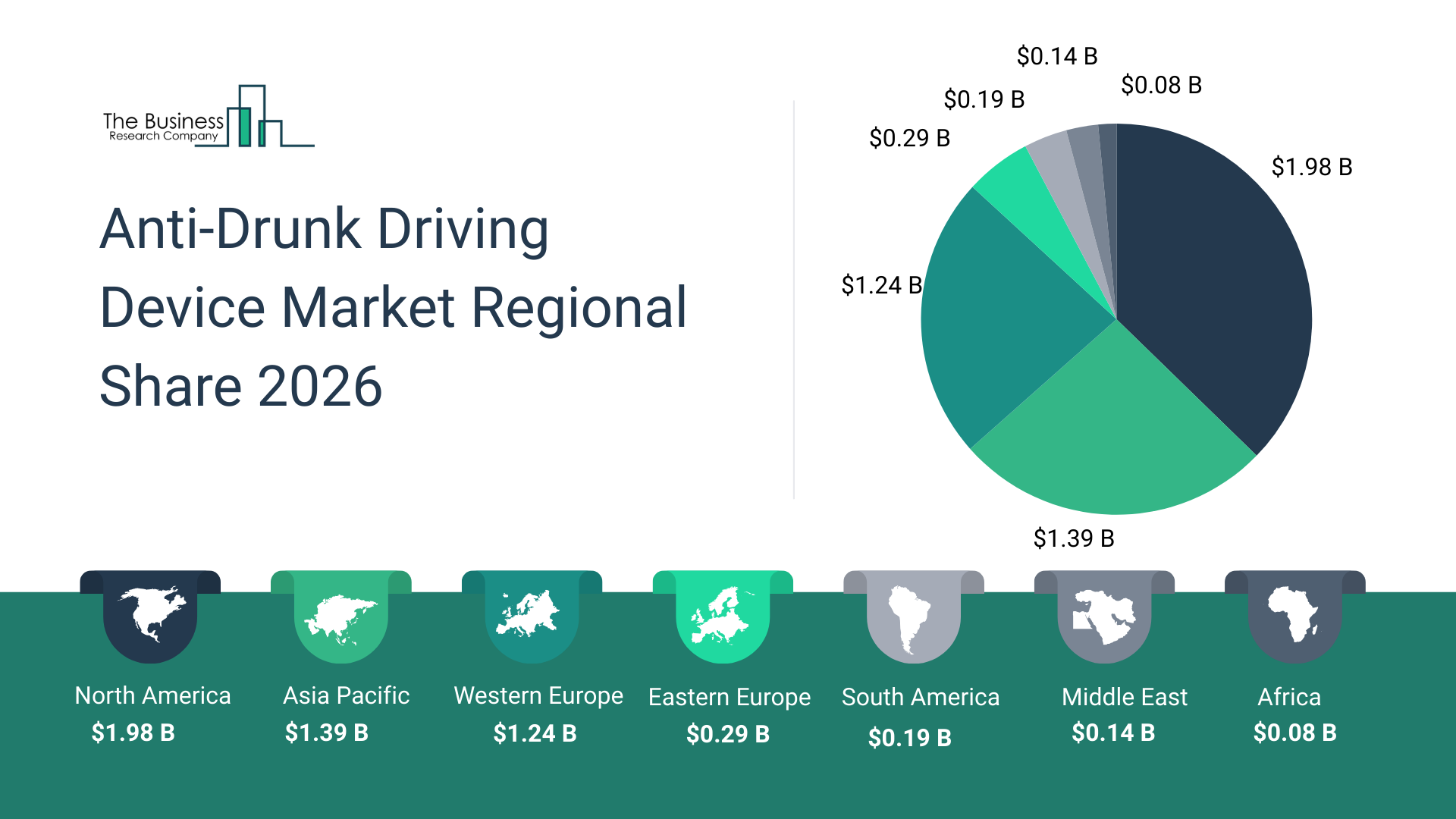
North America will be the largest region in the anti-drunk driving device market in 2030, valued at $3 billion. The market is expected to grow from $2 billion in 2025 at a compound annual growth rate (CAGR) of 9%. The strong growth can be attributed to stringent government regulations on driving under the influence, widespread adoption of ignition interlock and wearable monitoring devices, robust automotive and smart vehicle technology infrastructure, growing collaboration between law enforcement agencies and technology providers, and increasing public awareness campaigns promoting road safety across the USA and Canada.
Which Will Be The Largest Country In The Global Anti-Drunk Driving Device Market In 2030?
The USA will be the largest country in the anti-drunk driving device market in 2030, valued at $2 billion. The market is expected to grow from $2 billion in 2025 at a compound annual growth rate (CAGR) of 9%. The strong growth can be attributed to the large installed base of court-mandated ignition interlock programs across multiple states, expanding use of remote alcohol monitoring solutions for offender rehabilitation programs, strong presence of leading alcohol detection device manufacturers and service providers, increasing deployment of fleet-based driver alcohol monitoring systems in commercial transportation, and continuous technological advancements in sensor accuracy and connected monitoring platforms across the country.
Request A Free Sample Of The Anti-Drunk Driving Device Market Report
https://www.thebusinessresearchcompany.com/sample_request?id=18955&type=smp&utm_source=EINPresswire&utm_medium=Paid&utm_campaign=Mar_PR
What Will Be Largest Segment In The Anti-Drunk Driving Device Market In 2030?
The anti-drunk driving device market is segmented by type into ignition interlock device, lane departure warning system, and other types. The ignition interlock device market will be the largest segment of the anti-drunk driving device market segmented by type, accounting for 51% or $4 billion of the total in 2030. The ignition interlock device market will be supported by the increasing government mandates for DUI prevention, rising adoption of vehicle safety and monitoring technologies, advancements in breathalyzer and biometric sensor integration, collaborations between automobile manufacturers and technology providers, and growing awareness of road safety and legal compliance among drivers.
The anti-drunk driving device market is segmented by distribution channel into original equipment manufacturers (OEMS), and aftermarket.
The anti-drunk driving device market is segmented by application into passenger car, and commercial car.
What Is The Expected CAGR For The Anti-Drunk Driving Device Market Leading Up To 2030?
The expected CAGR for the anti-drunk driving device market leading up to 2030 is 9%.
What Will Be The Growth Driving Factors In The Global Anti-Drunk Driving Device Market In The Forecast Period?
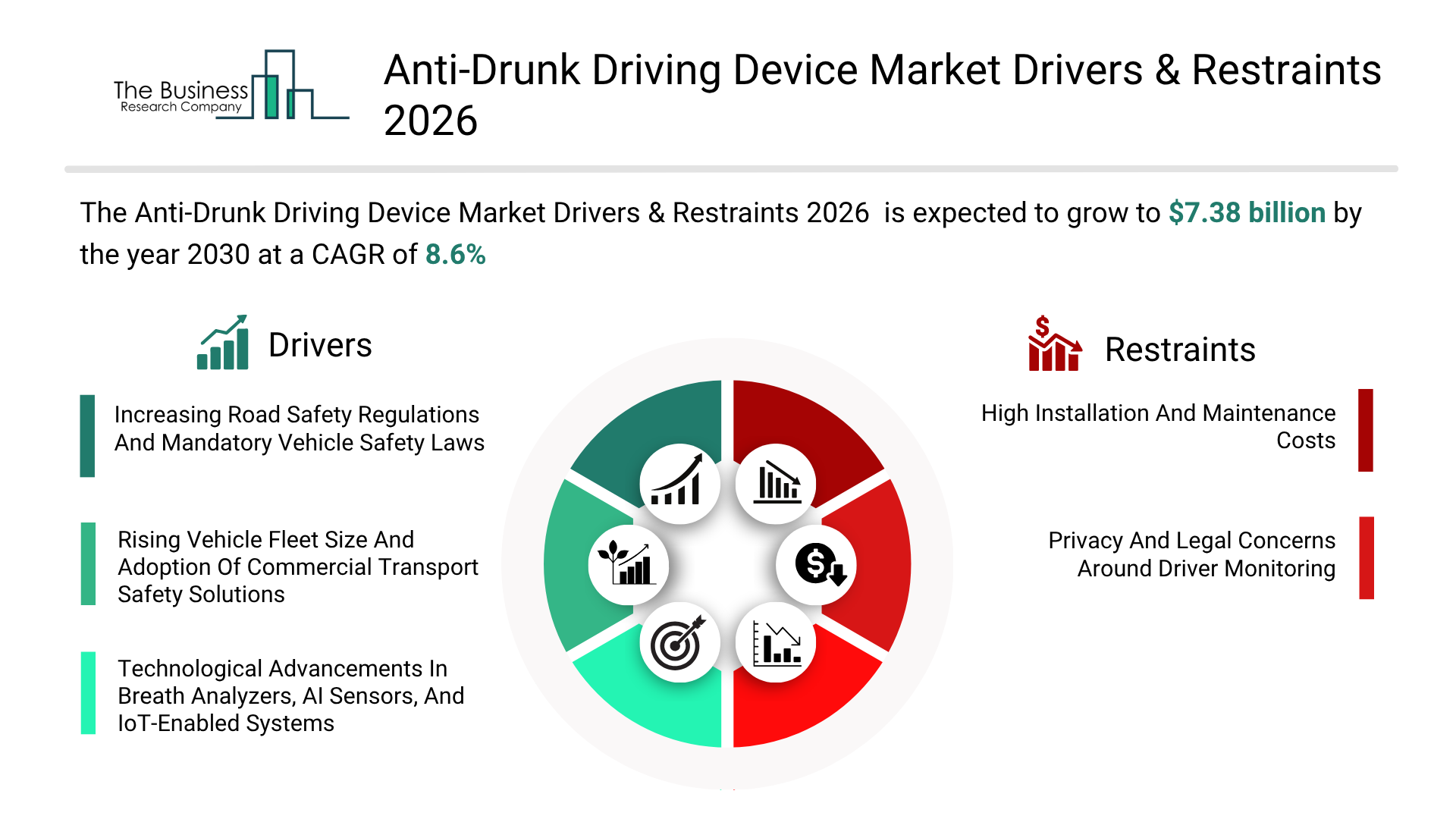
The rapid growth of the global anti-drunk driving device market leading up to 2030 will be driven by the following key factors that are expected to reshape vehicle safety standards, regulatory compliance frameworks, fleet management protocols, and innovation across global automotive safety ecosystems.
Increasing Road Safety Regulations and Mandatory Vehicle Safety Laws - The increasing road safety regulations and mandatory vehicle safety laws are expected to become a key growth driver for the anti-drunk driving device market by 2030. Governments worldwide are introducing stricter traffic safety regulations, zero-tolerance drunk driving laws, and mandatory installation of alcohol detection devices in commercial and personal vehicles. Enforcement initiatives, including frequent sobriety checks and penalties for impaired driving, are compelling vehicle manufacturers and fleet operators to integrate anti-drunk driving devices. The legal push for safer roads, combined with rising public awareness about traffic fatalities due to alcohol, is driving widespread adoption and regulatory compliance, making legislation the primary growth driver. As a result, the increasing road safety regulations and mandatory vehicle safety laws are anticipated to contributing to 2.9% annual growth in the market.
Rising Vehicle Fleet Size and Adoption of Commercial Transport Safety Solutions - The rising vehicle fleet size and adoption of commercial transport safety solutions are expected to emerge as a major factor driving the expansion of the anti-drunk driving device market by 2030. The expanding automotive fleet, particularly in commercial vehicles, taxis, buses, and ride-hailing services, is significantly increasing demand for in-vehicle alcohol detection systems. Fleet operators are adopting these devices to ensure driver sobriety, reduce accident liability, and lower insurance costs. Additionally, the growing emphasis on corporate social responsibility and passenger safety in logistics and public transport sectors is reinforcing consistent deployment of anti-drunk driving technology. Consequently, the rising vehicle fleet size and adoption of commercial transport safety solutions are projected to contribute to around 2.2% annual growth in the market.
Technological Advancements in Breath-Analyzers, AI Sensors, and IoT-Enabled Systems - The technological advancements in breath-analyzers, AI sensors, and IoT-enabled systems are expected to act as a key growth catalyst for the anti-drunk driving device market by 2030. Advances in sensor accuracy, AI-based alcohol detection, IoT connectivity, and integration with vehicle ignition systems are making anti-drunk driving devices more reliable, convenient, and user-friendly. Modern devices offer features such as automatic engine immobilization, real-time monitoring, mobile alerts, and fleet telematics integration, increasing trust and adoption among consumers and operators. Continuous innovation and decreasing device costs are further facilitating market penetration across both personal and commercial vehicle segments. Therefore, the technological advancements in breath-analyzers, AI sensors, and IoT-enabled systems are projected to contribute to approximately 1.7% annual growth in the market.
Access The Detailed Anti-Drunk Driving Device Report Here
https://www.thebusinessresearchcompany.com/report/anti-drunk-driving-device-global-market-report?utm_source=EINPresswire&utm_medium=Paid&utm_campaign=Mar_PR
What Are The Key Growth Opportunities In The Anti-Drunk Driving Device Market In 2030?
The most significant growth opportunities are anticipated in the ignition interlock device market, the lane departure warning system market, and the other product types market. Collectively, these segments are projected to contribute over $2 billion in market value by 2030, driven by increasing government regulations for road safety, rising consumer awareness of DUI prevention technologies, advancements in vehicle-integrated safety systems, growing partnerships between automotive manufacturers and technology providers, and expansion of insurance incentives for safer driving practices. This surge reflects the accelerating focus on reducing drunk driving incidents, enhancing vehicle safety, and promoting responsible driving behavior, fuelling transformative growth within the automotive safety technology industry.
The ignition interlock device market is projected to grow by $1 billion, the lane departure warning system market by $1 billion, and the other types market by $0.5 billion over the next five years from 2025 to 2030.
Learn More About The Business Research Company
The Business Research Company (www.thebusinessresearchcompany.com) is a leading market intelligence firm renowned for its expertise in company, market, and consumer research. We have published over 17,500 reports across 27 industries and 60+ geographies. Our research is powered by 1,500,000 datasets, extensive secondary research, and exclusive insights from interviews with industry leaders.
We provide continuous and custom research services, offering a range of specialized packages tailored to your needs, including Market Entry Research Package, Competitor Tracking Package, Supplier & Distributor Package and much more.
Disclaimer: Please note that the findings, conclusions and recommendations that TBRC Business Research Pvt Ltd delivers are based on information gathered in good faith from both primary and secondary sources, whose accuracy we are not always in a position to guarantee. As such TBRC Business Research Pvt Ltd can accept no liability whatever for actions taken based on any information that may subsequently prove to be incorrect. Analysis and findings included in TBRC reports and presentations are our estimates, opinions and are not intended as statements of fact or investment guidance.
Contact Us:
The Business Research Company
Americas +1 310-496-7795
Europe +44 7882 955267
Asia & Others +44 7882 955267 & +91 8897263534
Email: info@tbrc.info
Follow Us On:
LinkedIn: https://in.linkedin.com/company/the-business-research-company"
Oliver Guirdham
The Business Research Company
+44 7882 955267
info@tbrc.info
Visit us on social media:
LinkedIn
Facebook
X
Legal Disclaimer:
EIN Presswire provides this news content "as is" without warranty of any kind. We do not accept any responsibility or liability for the accuracy, content, images, videos, licenses, completeness, legality, or reliability of the information contained in this article. If you have any complaints or copyright issues related to this article, kindly contact the author above.
