

MNP Consumer Debt Index: Canadians Brace for Challenging 2026
Majority of Canadians Anticipate Higher Living Costs (71%), Rising Housing Pressure (59%), Worsening Economy (59%), Interest Rate and Inflation Strain (54%), and Job Market Weakness (52%) This Year
CALGARY, Alberta, Jan. 12, 2026 (GLOBE NEWSWIRE) -- Canadians are heading into the new year bracing for mounting financial challenges, with a strong majority (71%) expecting the cost of living to worsen. According to the latest MNP Consumer Debt Index conducted quarterly by Ipsos, this pessimism extends well beyond prices, reflecting a broader sense that economic conditions will deteriorate in 2026.
“There is a widespread sense that household finances will come under increasing pressure, fueling heightened anxiety about economic security in the year ahead,” explains Grant Bazian, president of MNP LTD, the country’s largest insolvency firm. “Canadians expect most aspects of daily life to worsen rather than improve in 2026.”
A majority believe the economy overall will worsen (59%) this year, and as many expect housing affordability to deteriorate (59%). Canadians also anticipate rising pressure from interest rates and inflation (54%), unemployment and the job market (52%), and Canada’s relationship with the United States (51%). Canadians believe everyday financial pressures will intensify, with the majority anticipating higher taxes (53%), and about half expecting transportation (50%) and healthcare costs (48%) to worsen. The majority also have concerns about rising poverty and inequality (62%) as well as worsening government deficit and debt (66%).
While Canadians express pessimism about what may come this year, there is some cause for optimism. The MNP Consumer Debt Index edged up one point from last quarter to 87 points, marking the first time since its inception that the Index has improved in December and bucking the typical seasonal trend of deteriorating debt sentiment.
Two in five Canadians (41%) say they are within $200 of not being able to pay their bills each month, down seven points from last quarter and the lowest level measured in the post-pandemic period. At the same time, the average amount Canadians have left after monthly expenses has risen by $163 since last quarter, now sitting at $907. While these gains point to modest financial relief, fewer than half of Canadians (47%) report having six months of emergency savings, leaving many households vulnerable to disruption.
“Despite pessimism about 2026, there are signs of cautious optimism, breaking from the Index’s usual seasonal decline and suggesting that some households are entering the new year with slightly more financial breathing room,” explains Bazian. “Whether Canadians respond to financial stress by taking action or avoiding their debt often comes down to how much financial flexibility they feel they have. For some, their breathing room has improved, enabling them to make adjustments and seek solutions. For others, ongoing economic uncertainty continues to drive debt avoidance. Sustained financial pressure is prompting both decisive action and withdrawal among Canadians.”
Financial Fight or Flight: How Canadians Are Responding to Financial Stress
As financial pressures intensify, Canadians are responding in markedly different ways. Nearly three in five (59%) are adopting a “fight” mentality, taking proactive steps such as adjusting their budgets (43%), attempting to consolidate debt (12%), or seeking advice from a financial professional (11%) as they try to regain control amid ongoing strain. At the same time, nearly one-third of Canadians (32%) are taking a “flight” response, including avoiding thinking about their financial responsibilities (12%), steering clear of financial discussions with family or professionals (15%), or relying on credit to cover essential expenses (17%). Meanwhile, fifteen percent (15%) say they feel financially frozen, unsure where to even begin when facing financial stress.
“Even when there are small signs of financial improvement, the concern with many Canadians being in financial flight mode is that it can create a false sense of short-term relief,” says Bazian. “Avoiding bills and conversations about finances or relying more heavily on credit can make financial stress feel manageable in the moment, but those behaviours often allow problems to grow quietly in the background. As Canadians head into an uncertain year, that can make it harder to regain control later on.”
Younger Canadians aged 18–34 are significantly more likely to lean toward a flight response (51%) when under financial stress, as are lower-income earners, with one-third of Canadians earning under $40,000 reporting similar behaviours (34%). This younger age group is also the most likely to feel financially paralyzed (23%) compared to other age groups, and is more likely to avoid discussing financial matters with family or professionals (22%).
Interest Rate Sensitivity Leaves Canadians Financially Exposed
While the Bank of Canada held its last policy interest rate at 2.25%, rates remain a critical source of stress for Canadians. Nearly two in three (64%, +1 pt) say they urgently need interest rates to come down. Even then, relief may be limited: nearly half (48%, +4 pts) remain concerned about their ability to repay debt, and more than two in five (44%, +2 pts) fear that a future increase in rates could push them toward bankruptcy. For heavily indebted households, these concerns underscore just how thin the margin for financial stability remains as they look ahead to the coming year.
“Even where Canadians see some improvement in their own debt situation, confidence about the year ahead remains fragile, particularly among those carrying high levels of debt,” says Bazian. “For these households, ongoing affordability challenges and borrowing costs leave little room for error as they head into 2026.”
Debt Stress Runs High, Yet Professional Help Remains Underused
Despite widespread concern about costs, debt, and the year ahead, relatively few Canadians are turning to professional support when facing financial stress. Just over one in 10 Canadians (11%) say they have sought advice from a financial professional as part of their efforts to fight back against financial strain. Fifteen percent (15%) avoid discussing financial matters with family or professionals altogether, while one in 10 (12%) avoid any kind of thinking about their financial responsibilities.
These findings echo a recent joint consumer alert from the Office of the Superintendent of Bankruptcy (OSB) and the Canadian Association of Insolvency and Restructuring Professionals (CAIRP), which highlighted how stress and stigma can prevent Canadians from asking for help and delay access to trusted, regulated guidance from Licensed Insolvency Trustees — professionals qualified to help individuals understand all available options and provide judgment-free support.
“Too many Canadians are trying to navigate financial challenges in isolation. There are government-regulated professionals available to help indebted Canadians understand debt-relief options, make informed decisions, and prevent financial stress from escalating,” says Bazian.
Licensed Insolvency Trustees are the only federally regulated professionals in Canada authorized to administer government-regulated debt solutions such as consumer proposals and bankruptcies. They are required to assess an individual’s full financial situation and explain all available options, including non-insolvency alternatives, so Canadians can make informed decisions based on their circumstances.
“What many people don’t realize is that not all debt advice is the same,” says Bazian. “When someone is under financial stress, they can be vulnerable to misinformation or quick-fix promises. Working with a trusted, federally regulated professional such as a Licensed Insolvency Trustee helps ensure Canadians receive unbiased guidance that looks at their full financial situation and all of the debt relief options available.”
With more than 200 offices nationwide, MNP LTD’s team of Licensed Insolvency Trustees offer local, personalized and non-judgmental support to help Canadians make sense of their financial options and move forward with clarity during periods of financial distress.
About MNP LTD
MNP LTD, a division of the national accounting firm MNP LLP, is the largest insolvency practice in Canada. For more than 50 years, our experienced team of Licensed Insolvency Trustees and advisors have been working with individuals to help them recover from times of financial distress and regain control of their finances. With more than 240 offices from coast-to-coast, MNP helps thousands of Canadians each year who are struggling with an overwhelming amount of debt. Visit MNPdebt.ca to contact a Licensed Insolvency Trustee or use our free Do-it-Yourself (DIY) debt assessment tools. For regular, bite-sized insights about debt and personal finances, subscribe to the MNP 3-Minute Debt Break Podcast.
About the MNP Consumer Debt Index
The MNP Consumer Debt Index measures Canadians’ attitudes toward their consumer debt and gauges their ability to pay their bills, endure unexpected expenses, and absorb interest-rate fluctuations without approaching insolvency. Conducted by Ipsos and updated quarterly, the Index is an industry-leading barometer of financial pressure or relief among Canadians.
Now in its thirty-fifth wave, the Index has made a modest one-point uptick from last quarter to 87 points. Visit MNPdebt.ca/CDI to learn more.
The data was compiled by Ipsos on behalf of MNP LTD between November 28 and December 1, 2025. For this survey, a sample of 2,001 Canadians aged 18 years and over was interviewed. Weighting was then employed to balance demographics to ensure that the sample's composition reflects that of the adult population according to Census data and to provide results intended to approximate the sample universe. The precision of Ipsos online polls is measured using a credibility interval. In this case, the poll is accurate to within ±2.7 percentage points, 19 times out of 20, had all Canadian adults been polled. The credibility interval will be wider among subsets of the population. All sample surveys and polls may be subject to other sources of error, including, but not limited to coverage error, and measurement error.
Provincial data is available upon request.
CONTACT
Angela Joyce, Media Relations
p. 1.403.681.9286
e. angela.joyce@mnp.ca
A photo accompanying this announcement is available at https://www.globenewswire.com/NewsRoom/AttachmentNg/bddc146a-6fb4-432e-affc-414f9e8a8dd2


MNP Consumer Debt Index - January 2026
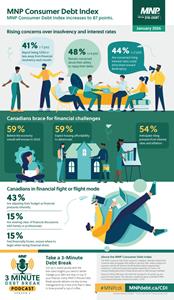
The MNP Consumer Debt Index edged up one point from last quarter to 87, even as Canadians remain concerned about insolvency risks, interest-rate pressures, and the financial challenges they expect to face in 2026.
Legal Disclaimer:
EIN Presswire provides this news content "as is" without warranty of any kind. We do not accept any responsibility or liability for the accuracy, content, images, videos, licenses, completeness, legality, or reliability of the information contained in this article. If you have any complaints or copyright issues related to this article, kindly contact the author above.
